
I'm going to say something most cash buyers won't: yes, some cash home buyer operations in NC are scams. If you searched "cash home buyer scam NC" and landed here, good. You should be skeptical. That skepticism will protect you.
The industry I work in has real bad actors. People who mail postcards to distressed homeowners in Durham and Fayetteville, show up promising all-cash quick closes, and then drag the process out, lower the number at the last second, or disappear entirely after tying up your property for 90 days. I've seen it happen to sellers in Wake County, Cumberland County, and Mecklenburg County. It makes me angry because it makes the rest of us look bad.
My name is Ryan Smith. I run Cinch Home Buyers out of 2500 Regency Parkway in Cary, NC. I've personally closed over 150 transactions across North Carolina. We're BBB accredited, registered with the NC Secretary of State, and carry a 4.9-star rating across our Google reviews from actual NC sellers. Every one of our closings goes through Gold Law PA, a licensed North Carolina closing attorney.
This is not a sales pitch. It's a guide. Use it on me, too. If Cinch doesn't check every green flag on this list, don't hire us.
First — Why Does This Industry Attract Bad Actors?
No licensing requirement. That's the short answer.
In North Carolina, anyone can print a "We Buy Houses" bandit sign and start making calls. You don't need a real estate license to buy houses or to claim you're a "cash buyer." The NC Real Estate Commission requires a license to represent someone else in a transaction, but buying for yourself requires nothing but a business card and an internet connection.
Now combine that with sellers who are dealing with foreclosure in Johnston County, a death in the family in Guilford County, a divorce in Mecklenburg County, or a house in east Raleigh that needs $60,000 in work. Vulnerable people making fast decisions under pressure. That's the environment that attracts people who want to exploit it.
I'm not saying this to scare you away from cash sales. A fair cash offer is the right move for a lot of NC homeowners. I'm saying it so you go in with your eyes open.
The 7 Red Flags — Walk Away Immediately
The 7 Green Flags — These Are the Buyers Worth Talking To
| Indicator | Scam / Wholesaler | Legitimate Cash Buyer |
|---|---|---|
| Proof of funds | Stalls or cannot provide | Bank statement or POF letter ready |
| Google reviews | Zero or fake/generic reviews | Detailed reviews from real NC sellers |
| Closing attorney | Suggests title company or notary only | Names a specific licensed NC attorney |
| Due diligence period | 60–90 days with no earnest money | 10–14 days with $1K–$5K earnest |
| Offer price at closing | Drops last minute | Matches the signed contract |
"Three realtors told me the house needed $30K in work before they'd list it. Cinch bought it as-is for cash." — James H., Winston-Salem
How Cinch Specifically Handles Each of These
I said at the start to use this list on me too. So here's how Cinch stacks up, point by point.
Proof of funds: We buy with our own capital. We can provide a proof-of-funds letter before you accept an offer. No assignment to some buyer you've never met.
Offer stability: The number we quote is the number we close at. If something genuinely unexpected comes up during inspection, we talk about it openly. We don't spring a lower number on you three days before closing.
No pressure: Take 48 hours. Take a week. Show the offer to your neighbor who used to be in real estate. We don't do expiring offers. Read what our sellers say about the process.
Track record: Over 150 closed deals across North Carolina, from Raleigh to Charlotte to Durham. 4.9 stars across our Google reviews. BBB accredited. Google "Cinch Home Buyers" and read the reviews yourself. Call us and ask for references from sellers in your county.
Closing attorney: Every Cinch transaction closes through Gold Law PA, a licensed NC closing attorney. We tell you the firm name before you sign anything. The attorney holds funds in escrow and disburses at close. You are protected by the same legal process that covers every home sale in North Carolina.
Due diligence and earnest money: We typically need 10 to 14 days for due diligence. We post real earnest money that reflects our commitment. We don't tie up properties with the intent to reassign.
Contracts: We use the NC Bar's standard Offer to Purchase form. Clean. Understood by every NC real estate attorney. Take it to your lawyer. We expect you to.
Who you're dealing with:Ryan Smith and the Cinch team operate out of 2500 Regency Parkway, Cary, NC. We're registered with the NC Secretary of State. When you call (919) 751-6768, you get a real person in the Triangle, not a call center in another state.
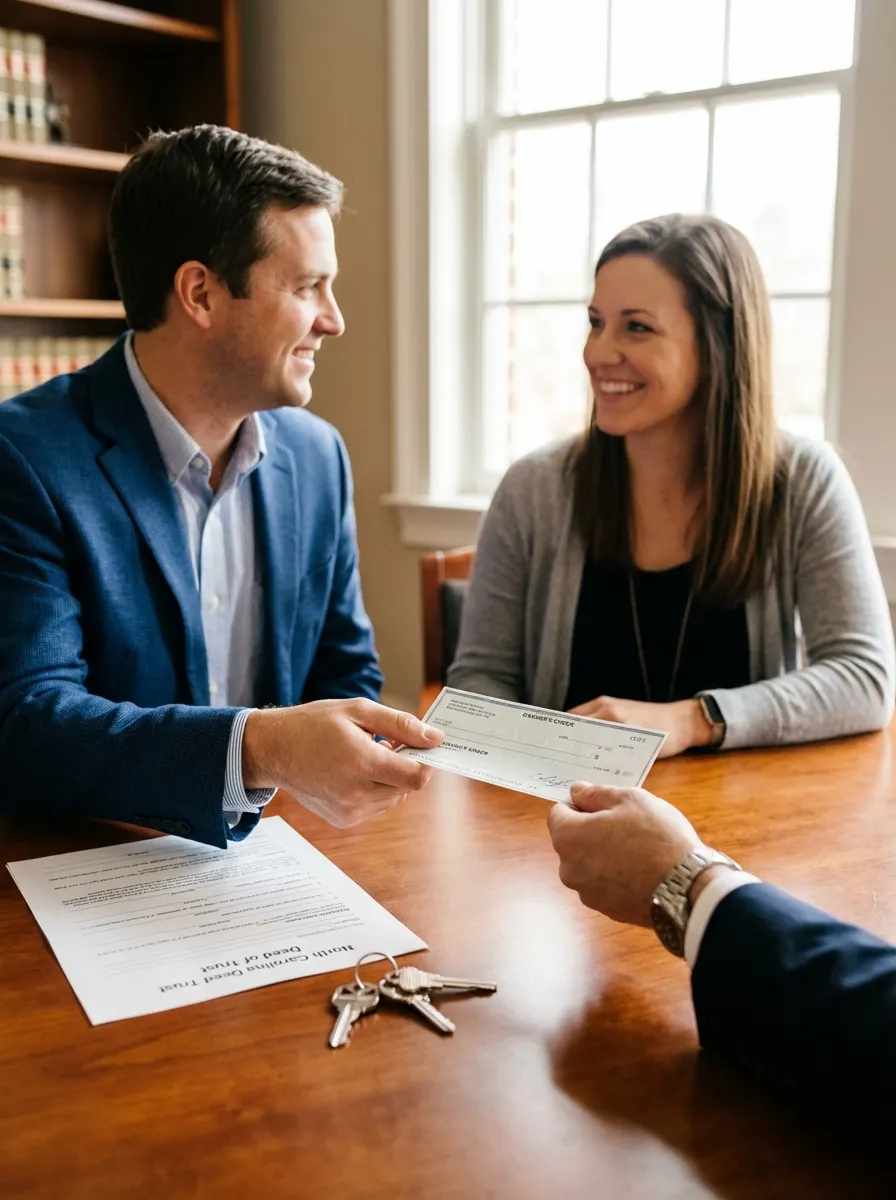
What to Do If You've Already Signed with a Bad Actor
First — don't panic. You still have options.
If you're still inside the due diligence period, the buyer typically has the right to exit, but so might you, depending on how the contract is written. Have a real estate attorney review the purchase agreement immediately. They can tell you what your exit rights are and whether the buyer has violated any terms.
If the buyer has already backed out and you lost time on your sale, document everything. Emails, texts, recorded calls if you have them. If they held a real estate license, file a complaint with the NC Real Estate Commission. For general consumer fraud, the NC Attorney General's Consumer Protection Division takes complaints online.
If someone forged your signature, transferred your deed without your knowledge, or committed any form of deed fraud, contact law enforcement immediately and consult an attorney about an emergency injunction to stop the sale.
Losing time hurts, especially if you were in a time-sensitive situation. But a bad contract doesn't have to mean the end of your options. If you called us after getting burned and you're still trying to sell, we'll start fresh with full transparency — no pressure, no rush.
The Bottom Line
Cash buyers are not automatically scams. They're also not automatically legitimate. The difference is transparency, track record, and whether they're willing to be verified.
The motivated seller market in NC is full of people who genuinely need a fast, fair solution. Foreclosure in Garner. Inherited properties in Hillsborough. Landlords done with problem tenants in east Durham. Military families PCSing out of Fayetteville. Most of them don't have time for a three-month listing process. Cash sales exist for real reasons.
But those real reasons also attract bad actors looking for distressed sellers they can exploit. Your job is to slow down just enough to run the 14 checks in this article. That's all. Takes about 30 minutes. It's the difference between a transaction that helps you and one that takes advantage of you.
Quick Verification Checklist
Before you sign with any cash buyer in North Carolina, confirm all of the following:
- They have a physical office address you can verify (not a PO box or virtual mailbox)
- They can show proof of funds from a bank or financial institution
- They have real Google reviews with detailed seller experiences
- They are BBB accredited or at minimum listed with a complaint history you can read
- They name a specific NC closing attorney and you can verify that attorney's license
- They are registered with the NC Secretary of State as a legal business entity
- They give you the offer in writing before asking you to sign anything
- They don't pressure you to sign today or use expiring-offer tactics
- Their contract uses reasonable due diligence terms and includes real earnest money
- They are willing to provide references from past sellers in your area
We put everything on the table at Cinch. Read what sellers say about us, see who you're working with, run the numbers yourself, and call (919) 751-6768 with every question you have. That's what a legitimate buyer looks like.
Frequently Asked Questions
Many are, and many are not. North Carolina has no specific licensing requirement to advertise as a "cash home buyer," which means anyone can print a bandit sign or mail a postcard. Legitimate buyers are verifiable — they have Google reviews, a physical address, a track record of closed deals, and they use a licensed closing attorney for every transaction. If a buyer cannot show you any of that, walk away.
The most common scheme is a wholesaler who ties up your property under contract, then spends the due diligence period trying to find an end buyer. If they can't assign the contract in time, they either back out or pressure you to lower your price. You've lost weeks or months of market time and ended up right back where you started — or worse, if your situation was time-sensitive.
No. A legitimate cash buyer will give you an offer with no strings attached before asking you to sign a purchase agreement. If someone pressures you to sign paperwork before they've even seen the house or quoted a number, that is a major red flag.
Search their company name on Google and read the reviews — not just the star rating, but what sellers actually describe. Check the Better Business Bureau at bbb.org for accreditation and complaint history. Look up their business name on the NC Secretary of State's website. Ask for the name of the closing attorney they use and verify that attorney holds an active NC law license at ncbar.gov. Ask for references from past sellers in your county. A real buyer will hand you all of this without hesitation.
Under a standard NC Offer to Purchase, the buyer posts earnest money — typically $1,000 to $3,000 — that goes to you if they walk away without a valid contractual reason. However, many wholesalers write contracts with broad due diligence exit clauses, which let them back out for almost any reason during that window. This is why it's critical to understand who you're signing with before you sign anything.
Yes. If the buyer held a real estate license, you can file a complaint with the NC Real Estate Commission at ncrec.gov. For general consumer fraud, the NC Attorney General's office handles consumer protection complaints. If the buyer used a licensed closing attorney who acted improperly, you can file with the NC State Bar.